LESSON 1 / 6 · ABOUT 8 MINUTES
Read the tiny label
What you’ll be able to explain
- Tell voltage, current and power apart.
- Separate an adapter’s wall input from its device output.
- Calculate a stated DC output without assuming actual consumption.
Start with the two sides
You borrow a charger before a video call. The large “65 W” catches your eye, but the small INPUT and OUTPUT lines answer different questions. INPUT describes the supply the adapter is designed to receive. OUTPUT describes what it can provide to the device. A travel plug that changes the shape of the plug does not, by itself, convert voltage. Follow the exact product’s instructions and local requirements.
Three quantities, three jobs
Voltage, measured in volts (V), is electrical potential difference. Current, measured in amperes (A), is the rate of electric charge flow. Power, measured in watts (W), is the rate of energy transfer. On a stated DC output, power is voltage multiplied by current: W = V × A.
The source’s rated current is an available capacity under its specified conditions, not a command that forces that current into every device. A compatible, properly operating device draws according to its load and charging control. This principle is about appropriate regulated supplies; it is not permission to substitute a random adapter.
A useful comparison is a restaurant’s seating capacity: a sign saying “60 seats” does not mean 60 customers are always eating. Likewise, “65 W maximum” does not mean 65 W is always being delivered. The analogy explains capacity only; it does not explain electrical hazards.
Decode the teaching label
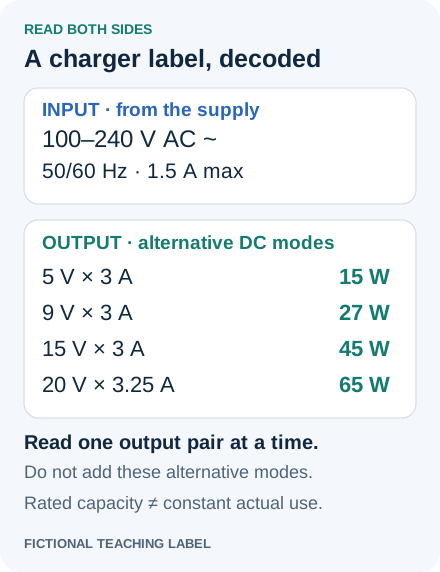
Our invented adapter label says INPUT: 100–240 V AC, 50/60 Hz, 1.5 A max. Those figures describe the adapter’s input operating conditions. They are not the voltage or current sent to the phone. The input current rating is not a meter reading or a reliable estimate of your electricity bill.
OUTPUT lists alternative DC modes: 5 V ⎓ 3 A; 9 V ⎓ 3 A; 15 V ⎓ 3 A; 20 V ⎓ 3.25 A. Read each voltage/current pair together. They calculate to 15 W, 27 W, 45 W and 65 W. Do not add them: these are alternative modes for this single-port example.
AC may be shown by a wave (~); DC by a solid line over a dashed line (⎓). Hz describes cycles per second. A value such as 2,000 mA equals 2 A. A battery energy label in Wh is a different quantity from a charger’s power label in W. At a constant 20 W for half an hour, the mathematical energy is 10 Wh; real charging includes changing power and losses.
Avoid the shortcut
Do not calculate an AC adapter’s real wall-power consumption simply as its maximum input voltage times its maximum input current. AC power factor, operating load and conversion losses matter. For this course, use W = V × A only on the stated DC examples. Exact performance claims require product documentation and appropriate measurements by competent personnel.
Read the diagram in words
Teaching adapter label: input 100 to 240 volts AC, 50 or 60 hertz; output alternatives of 15, 27, 45 or 65 watts. The alternatives are not added.
WORK IT THROUGH
Rated capacity versus actual output — A fictional compatible phone negotiates 9 V and currently draws 2 A from an adapter whose 9 V mode is rated up to 3 A.
- Calculate actual output in this stated condition: 9 × 2 = 18 W.
- Calculate that mode’s stated capacity: 9 × 3 = 27 W.
- Keep 18 W actual and 27 W capacity separate. The adapter’s 65 W maximum belongs to another mode.
The phone is using 18 W in this example. Nothing here proves battery charging efficiency or time to full.
Take it into the audit room
Record the exact model, INPUT line, OUTPUT mode and whether the number is rated or measured. A report that says only “65 W charger” can hide a voltage-mode mismatch.
MAKE THE CALL
Check your understanding.
Keep this in your pocket.
- Identify the exact device and adapter model from safely available labels or records.
- Copy INPUT and OUTPUT separately, including AC/DC and units.
- Keep each output voltage/current pair together; multiply only the stated DC pair when calculating watts.
- Label every figure as rated capacity, required capacity or actual measured data; do not mix them.
- Check the device manufacturer’s requirements before deciding compatibility.